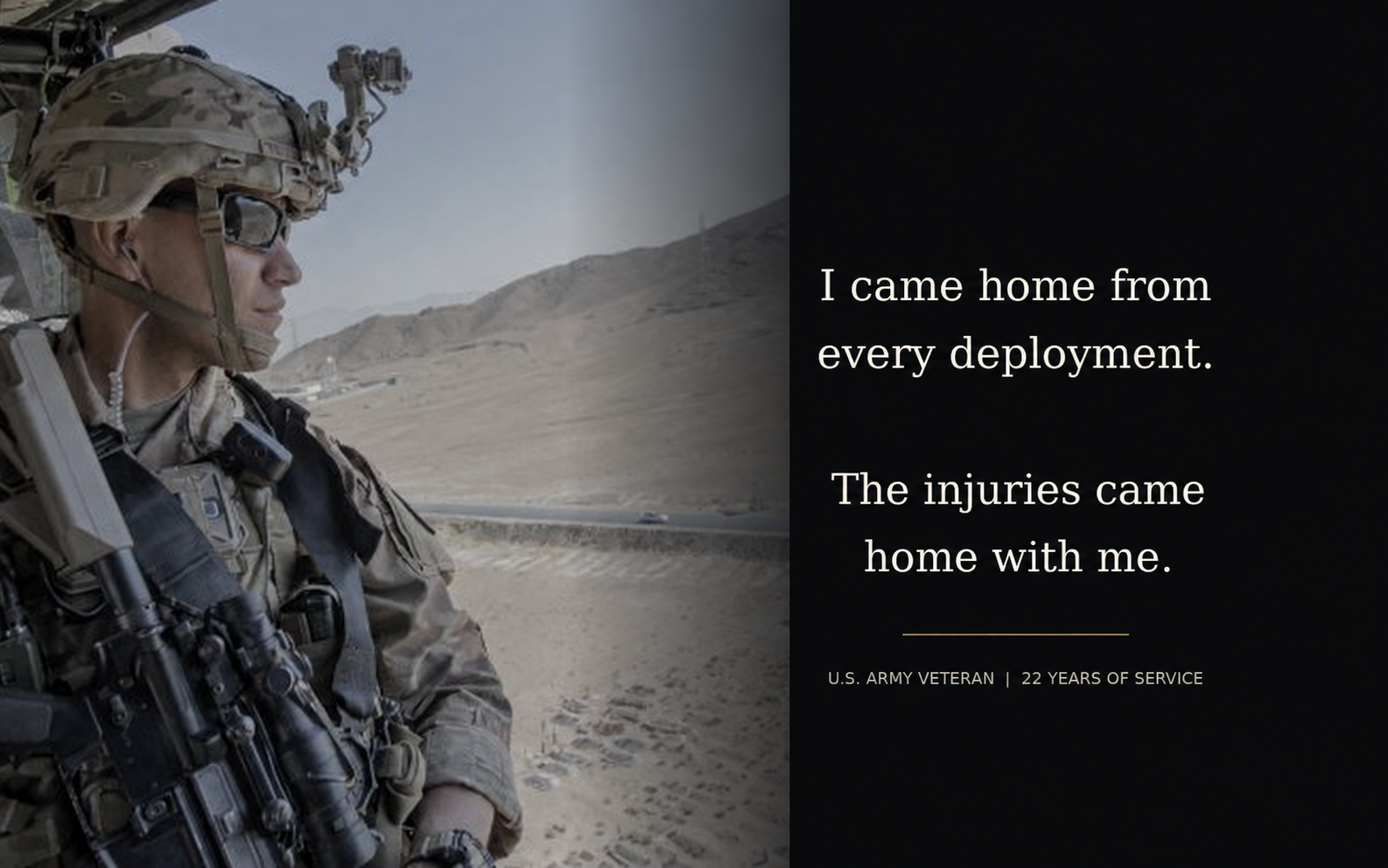
Service members and veterans deserve a clearer answer when pain persists and conventional scans do not explain it. We are working to bring movement into the medical evaluation.
Explore the complete finished book—from the Executive Brief and Founder's Letter to the veteran pathway, national pilot proposal, evidence, call to action, and promise.
Currently readingThe Movement — Volume I
Page 1 of 21
The mission
Every service member returning from deployment deserves a movement-based screening pathway. Every veteran deserves access to answers.
Injuries can happen through impact, blast exposure, repetitive strain, or sudden movement. MRI, CT, and standard X-rays provide essential information, but they usually show the body in a still position. Some instability becomes apparent only as a joint moves.
Our policy goal is a standard post-deployment screening pathway for every returning service member, with movement-based evaluation available to veterans. We are seeking an independently evaluated pilot to establish when Digital Motion X-ray helps, how findings change care, and how such a pathway can be delivered safely at scale.
Persistent pain after imaging
When the scans are called negative, the pain can still be real.
Doc John reports that every patient he sees has previously had MRI, CT, and X-ray imaging reported as negative, yet continues to live with pain—often for years. He sees this pattern across body areas, not only in the spine. This is his clinical observation, not a published patient study.
CLINICAL EXPERIENCE
A broader question than the spine alone.
The body area and clinical question vary from patient to patient. When appropriate, Digital Motion X-Ray adds a view of selected joints and body regions during movement. It complements the clinical evaluation and prior imaging; it does not replace them or answer every cause of pain.
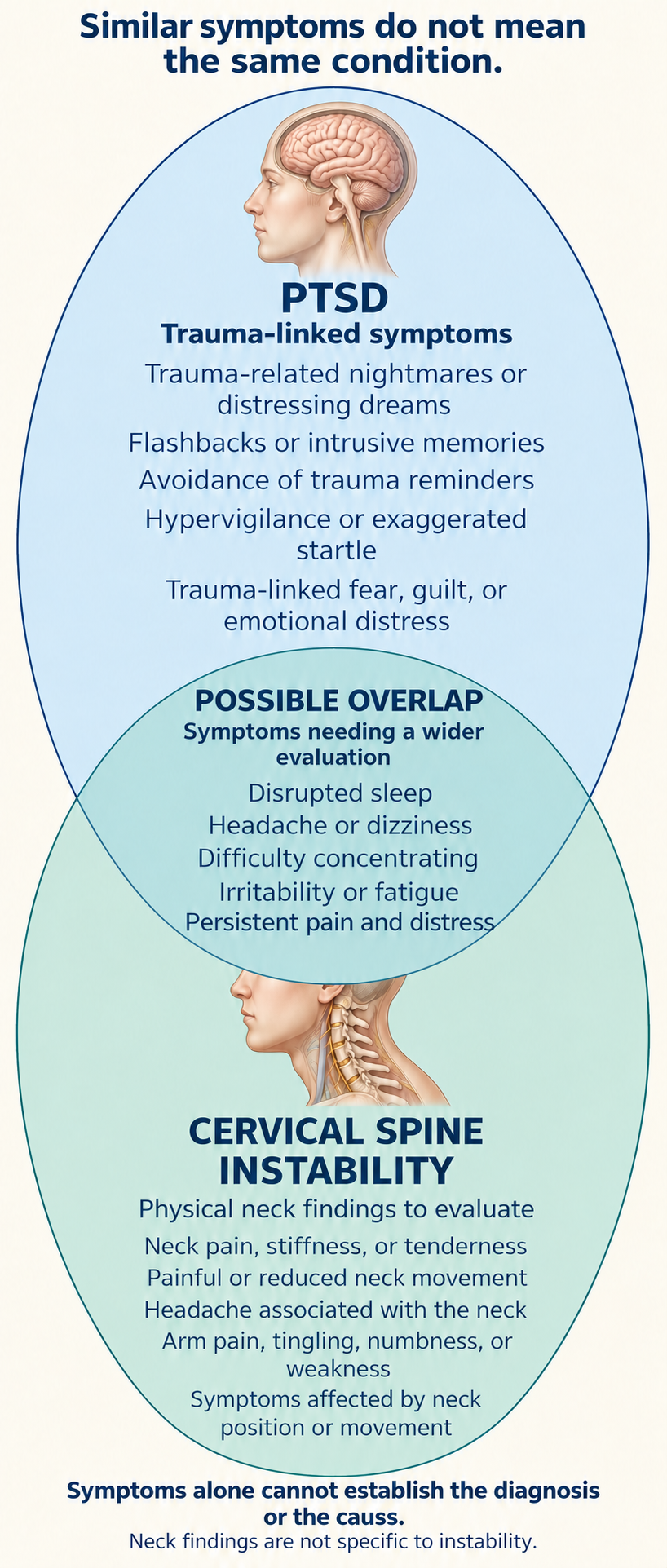
PTSD and cervical spine instability
Similar symptoms do not mean the same condition.
PTSD is a mental health condition related to traumatic exposure. Cervical spine instability is a physical condition involving abnormal movement between vertebrae in the neck. Either may occur on its own, and a person may also live with both. Symptoms alone cannot establish the diagnosis or the cause.
Symptoms alone cannot establish the diagnosis or the cause. Neck findings are not specific to instability.View diagram at full sizeRead the symptoms as text
More characteristic of PTSD
Trauma-linked symptoms
Trauma-related nightmares or distressing dreams
Flashbacks or intrusive memories
Avoidance of trauma reminders
Hypervigilance or exaggerated startle
Trauma-linked fear, guilt, or emotional distress
Cervical spine instability
Physical neck findings to evaluate
Neck pain, stiffness, or tenderness
Painful or reduced neck movement
Headache associated with the neck
Arm pain, tingling, numbness, or weakness
Symptoms affected by neck position or movement
Possible overlap
Symptoms needing a wider evaluation
Disrupted sleep
Headache or dizziness
Difficulty concentrating
Irritability or fatigue
Persistent pain and distress
When sleep itself feels unsafe
The nightmare can end. The attempt to escape it can continue.
For some veterans, trauma-related nightmares make going to sleep feel frightening. Some may use alcohol or other substances to fall asleep, numb painful thoughts and feelings, or try to prevent the dreams. The relief may feel immediate, but alcohol can make sleep less restful and substance use can worsen PTSD symptoms and overall health over time. This is a trauma-and-sleep pattern—not evidence of cervical instability—and both PTSD and substance use deserve care.
Trauma-related nightmares or sleep terrors should not be presented as proof of spinal instability. Digital Motion X-Ray does not diagnose PTSD. When symptoms overlap, appropriate care may involve mental-health, neurological, musculoskeletal, vestibular, or other clinical evaluation.
“I came home from deployment in my early 30s, but I am living in a body that feels like it is 80.”
That should never become normal.
The human reason
Coming home should not begin a search for answers.
A service member should not have to spend years proving that pain began during service. The original mechanism, symptoms, and medical record should move forward together—with the veteran.
The injury happens during service. The consequences can follow a veteran home.
The Movement exists to change what happens in between.
01Injury during deployment
Impact, blast exposure, repetitive load, training, transport, or another service-related mechanism.
02The body is assessed at rest
Emergency priorities come first. Once medically stable, some motion-dependent injuries may still remain difficult to see.
03The service member returns home
Care transitions, records move between systems, and the original mechanism can become separated from later symptoms.
04Pain becomes a life pathway
Unanswered symptoms can affect sleep, work, relationships, mental health, and exposure to long-term pain treatment.
The critical window
Capture the injury while the story is still intact.
Our proposed pathway begins after emergency stabilization and before the final transition home. It would document the injury mechanism and symptoms, then determine a safe movement-based evaluation with the treating team.
1Emergency careStabilize and treat immediate threats
2Medical evacuationPreserve mechanism, symptoms, and records
3Movement evaluationWhen medically stable, before transition home
4Connected care planCarry clear findings into DoD and VA follow-up
Why there? The mechanism of injury, timeline, symptoms, and treating team are still close together.
Why before home? A documented finding can travel with the service member instead of forcing them to rebuild the story years later.
Why motion? Because some symptoms and instability appear under movement or load, not only while lying or standing still.
This is VMHI's proposed policy, not a current DoD or VA screening requirement. The DoD already uses post-deployment health assessments around return and reassessment after redeployment. We are advocating for research and implementation planning to define where movement-based imaging belongs. DoD deployment-health data · VA chronic pain and PTSD guidance
The solution, delivered
Bring the evaluation to the veteran.
A mobile pathway can connect medically stable service members and veterans with movement-based evaluation, documented findings, and a clearer next step—without asking them to navigate another disconnected system alone.
When is movement-based imaging appropriate—and can it improve the path from unresolved symptoms to a clear clinical plan?
~12evaluations per day
4months of learning
1evidence-driven path forward
Why movement matters
A still image captures a moment. Digital Motion X-Ray captures motion.
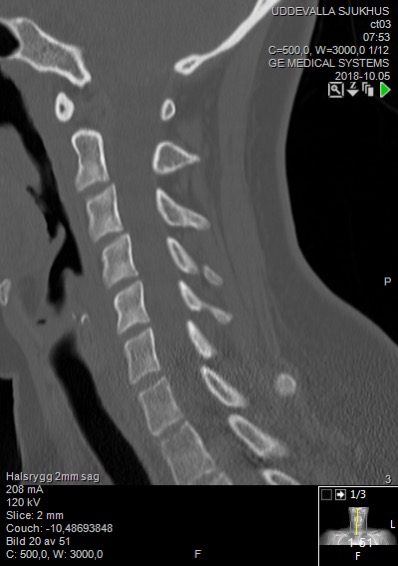
Digital Motion X-ray records continuous X-ray images while a joint moves. It may help clinicians evaluate certain patterns of ligament or joint instability that can be difficult to appreciate on static images.
MRI, CT, and static X-ray provide critical anatomical information while the body is still.
→
Imaging in motionCervical spine Digital Motion X-Ray example. Select play to watch.
Movement becomes information.
Digital Motion X-Ray adds a dynamic view designed to complement—not replace—MRI, CT, or static X-ray.
Separate educational examples, not scans of the same patient.
See what motion reveals
Not another still image. A living record of movement.
These short educational clips show why a moving joint can tell a different story than a single image captured at rest.
The equipment
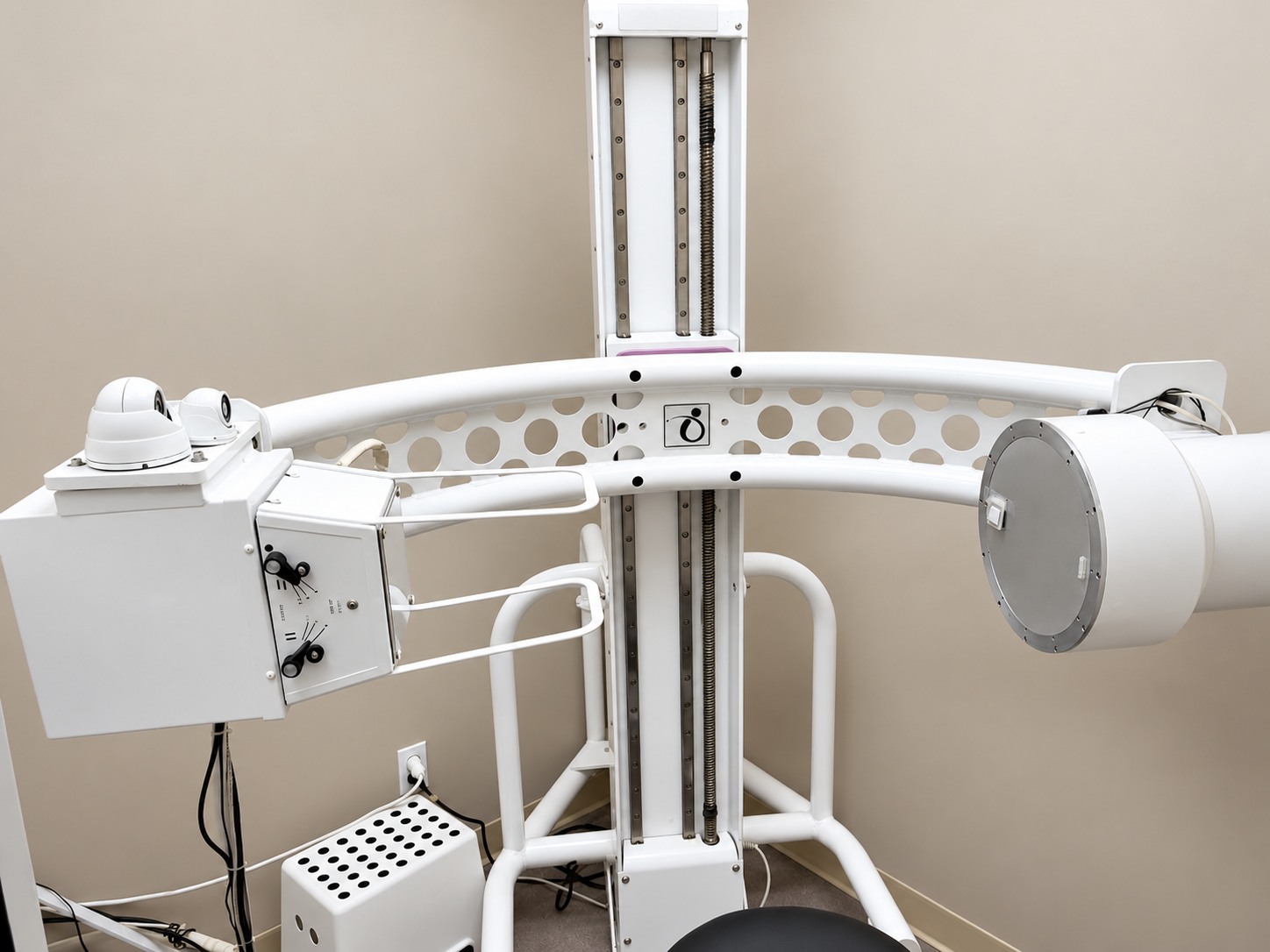
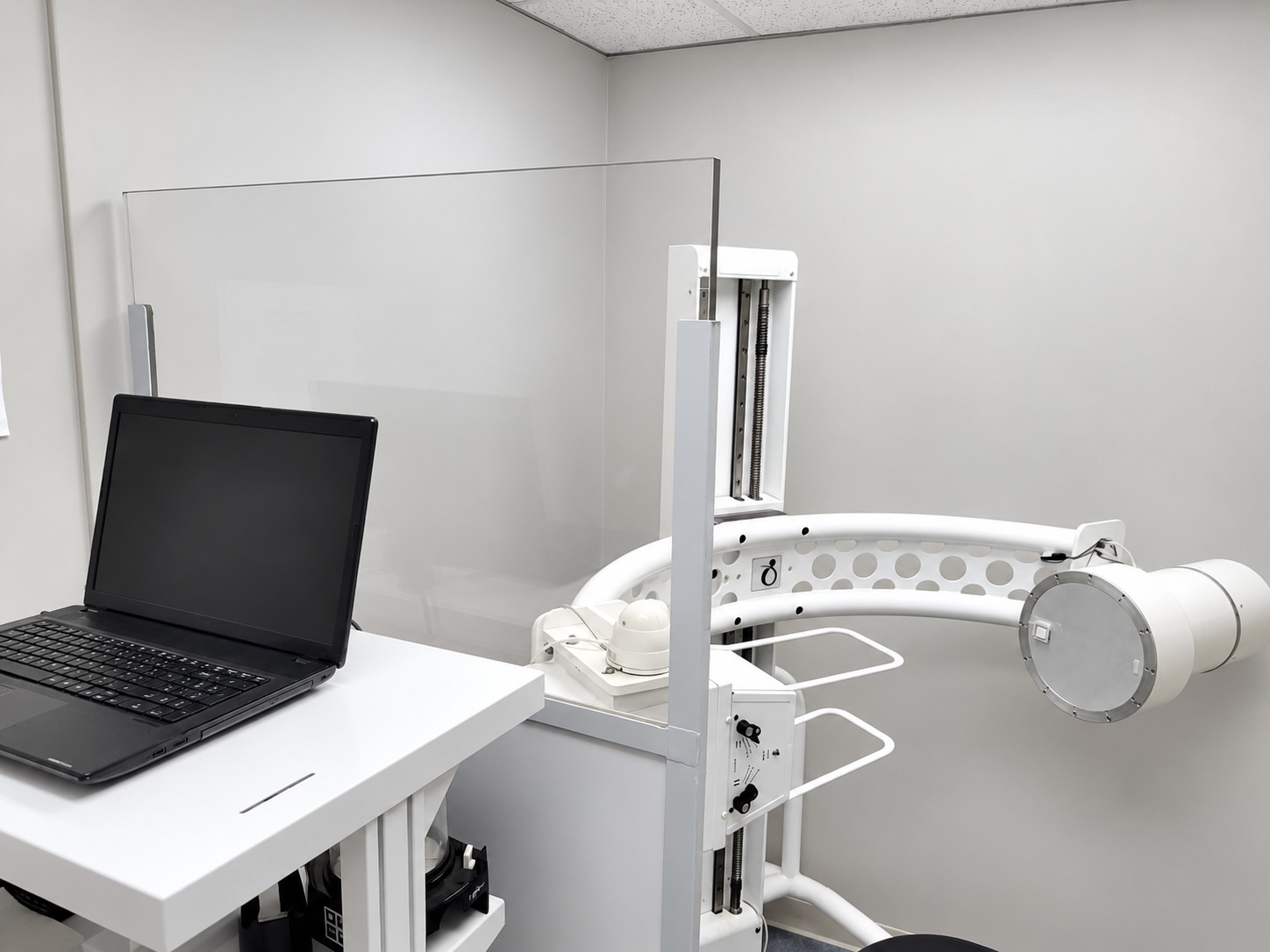
Actual system. Clinical setting.
Photos of the Digital Motion X-Ray system, including an equipment detail and an installation view.
Equipment detailImaging system close-upInstallation viewSystem and workstation
Introduction · 57 seconds
Digital Motion X-ray
See how continuous X-ray imaging records anatomy as the body moves—adding dynamic information to the clinical picture.
Technology in motion · 6 seconds
The evaluation happens while the body moves.
Movement example
Cervical spine
Movement example
Knee
Movement example
Shoulder
Movement example
Wrist
Movement example
Ankle
Educational examples only. Movement-based imaging is used by qualified clinicians when medically appropriate and is intended to complement—not replace—other imaging and clinical evaluation.
Why we cannot wait
Unanswered pain does not stay contained.
It can reach into sleep, work, relationships, mental health, and every part of daily life. When people do not have an explanation, they may spend years moving from appointment to appointment without a clear path forward.
VMHI is not promising that one test answers every question. We are demanding that motion-dependent injury be studied seriously, responsibly, and with the urgency veterans deserve.
01Pain without explanation
02Years without a clear path
03A life shaped by what was missed
The movement
Built with veterans. Proven through evidence.
This is how a powerful conviction becomes a credible pathway for change.
01
Listen
Center the lived experiences of veterans, service members, and the families who have carried unanswered questions with them.
02
Evaluate
Launch a structured, veteran-informed pilot with independent clinical and research oversight.
03
Measure
Study diagnostic findings, patient pathways, outcomes, and the practical realities of implementation.
04
Act
Turn credible evidence into informed VA, DoD, health-system, and policy decisions.
Evidence & references
Build the pathway on evidence.
These sources establish context for military blast exposure, whiplash-associated disorders, cervical injury burden, and the clinical discussion surrounding dynamic imaging. Each source supports a specific part of the case; no single paper establishes the entire proposed VMHI pathway.
01
Military blast injury · Review
Blast-Related Traumatic Brain Injury: Current Concepts and Research Considerations
Bryden DW, Tilghman JI, Hinds SR II. Journal of Experimental Neuroscience. 2019;13.
Reviews the distinctive mechanisms and research challenges of blast-related head trauma in service members, including the interaction of physical injury and psychological health.
Whiplash: Diagnosis, Treatment, and Associated Injuries
Yadla S, Ratliff JK, Harrop JS. Current Reviews in Musculoskeletal Medicine. 2008;1:65–68.
Describes the broad clinical presentation of whiplash-associated disorders and notes that ligamentous and bony injuries may go undetected during the initial evaluation.
Dynamic imaging · Clinical and medico-legal review
Documenting Cervical Spine Injuries Following Negative MRI Findings
Vernon LF, Benn A. Cureus. 2025.
Reviews cervical injury after trauma when MRI or CT findings are negative and discusses videofluoroscopy and other dynamic imaging in the evaluation of possible ligament instability.
Cervical injury burden · Comparative cross-sectional study
Estimating the Number of Traffic Crash-Related Cervical Spine Injuries in the United States
Freeman MD, Leith WM. Accident Analysis & Prevention. 2020;142:105571.
Compares national crash, emergency-department, inpatient, and insurance data to estimate the frequency of cervical spine injuries associated with traffic crashes.
Bartsch AJ, Gilbertson LG, Prakash V, Morr DR, Wiechel JF. Annals of Advances in Automotive Medicine. 2008;52:117–128.
Reports injury diagnoses in 105 minor rear-impact crashes. The authors caution that the litigation-referred cohort may limit how broadly the findings can be applied.
Research types and limitations are identified so readers can distinguish primary studies from scholarly reviews. Individual patient records and promotional materials are not included as scientific evidence.
The voices behind the Movement
Your service. Your experience. Your words.
We are collecting firsthand stories from veterans and service members about coming home, living with injuries, and finding care. Share what you want others to understand—in your own words.
Campaign message. Personal stories are shared only with the contributor’s permission and after review.
You decide what to share. Every submission starts privately.
Your experience matters
Tell us what coming home has been like for you.
Share some of your experiences serving our country and returning home. What could our healthcare system have done differently to better care for your overall health—including physical pain, pain management, and mental health?
You do not need a diagnosis or a particular experience to contribute. Tell us what happened, what helped, what is still unanswered, and what you wish others understood.
Private by default
Your story will be reviewed privately. It will not appear on this website or be shared publicly without your separate permission.
Your voice belongs here
Veterans must have a seat at the table.
Before policy is written, pilots are launched, or systems make decisions, we need to listen to the people who served. Your experience can help shape what comes next.